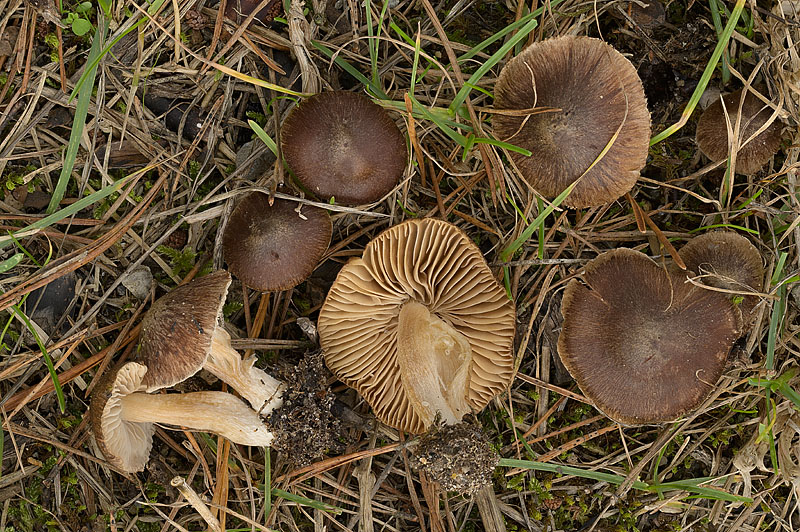
24 October 2024 Puttenham Common, Surrey. Photograph copyright Leif Goodwin. Cap Bell shaped, expanding with age, sometimes with a central bump, whitish veil remnants often present at the centre. radially fibrous, sometimes splitting radially to reveal paler flesh beneath, dark reddish brown to yellowish brown, to about 7 cm across Gills Broad, crowded, adnexed, whitish then pale brown, edges whitish Stem Equal, usually bulbous at the base, white when young, then pale brown from the base upwards, pruinose at the apex Flesh Whitish Smell Faint Taste Do not taste Season Summer to autumn Distribution Rarely recorded. Habitat On soil in woodland. Spore Print Walnut-brown Microscopic Features Spores almond shaped, smooth (8-11.5) x (5-6.5) µm2. Basidia club shaped, four spored. Gill edge cystidia mostly spindle shaped with a long neck and apical crystals, some balloon shaped. Gill face cystidia spindle shaped with a long neck and apical crystals. Stem cystidia spindle shaped with a long neck mostly with apical crystals, some balloon shaped. Edibility Poisonous Notes Rather similar to Inocybe phaeoleuca, the two species were once considered varieties, until DNA analysis showed them to be distinct 
Spores in Congo Red solution viewed with a 100X immersion objective. 24 October 2024 Puttenham Common, Surrey. Photograph copyright Leif Goodwin. 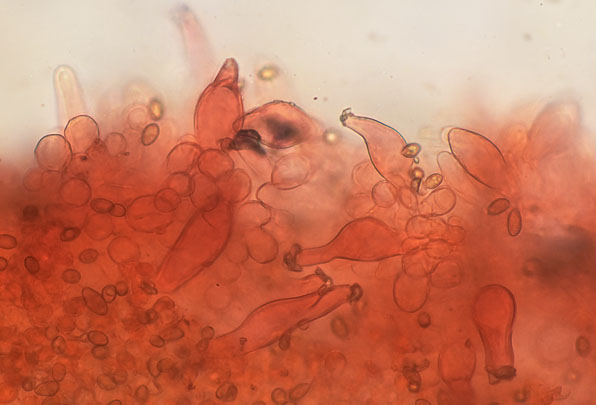
Gill cystidia in Congo Red solution viewed with a 40X objective. 24 October 2024 Puttenham Common, Surrey. Photograph copyright Leif Goodwin. 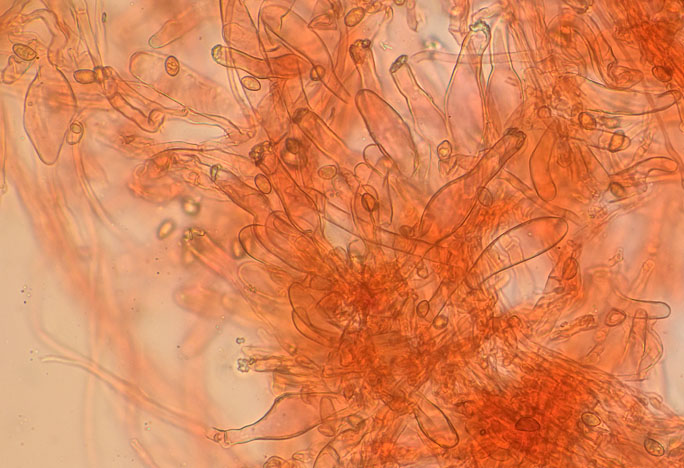
Stem apex cystidia in Congo Red solution viewed with a 40X objective. 24 October 2024 Puttenham Common, Surrey. Photograph copyright Leif Goodwin. |